David Bridges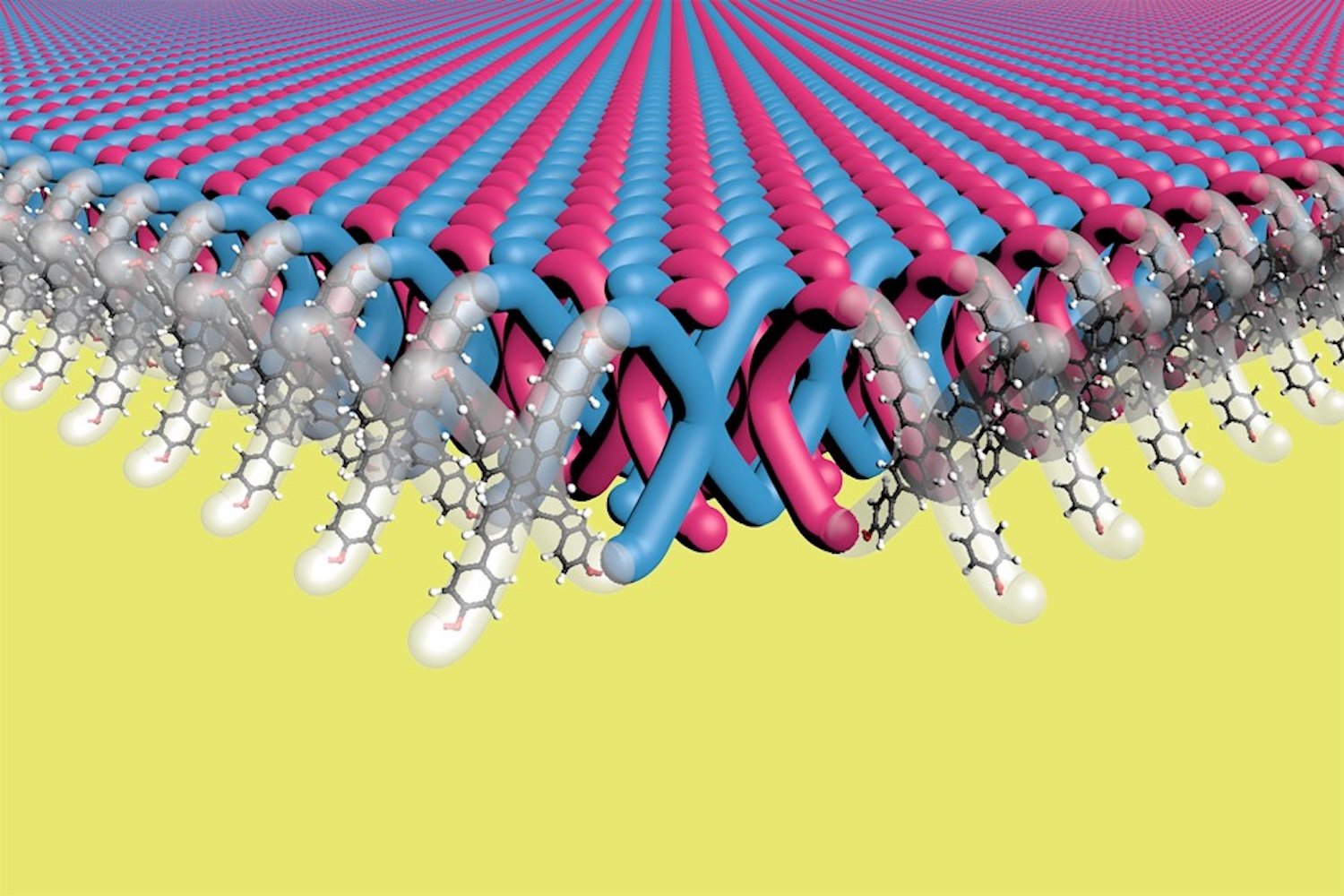
Revolutionary Lightweight Armor: A Breakthrough in Material Science
Imagine a protective layer that is as light as fabric yet possesses strength exceeding that of steel, constructed from innovative materials that interconnect like a molecular chainmail. This vision may soon transform into reality, as scientists have made significant strides toward developing such advanced armor.

Introducing the First Two-Dimensional Mechanically Interlocked Material
A pioneering team of researchers, spearheaded by scientists from Northwestern University, has unveiled what could be the first two-dimensional (2D) mechanically interlocked material. This revolutionary material, detailed in a study published on January 16 in the journal Science, exhibits remarkable flexibility and strength, paving the way for potential applications in lightweight body armor, ballistic fabrics, and beyond.
Understanding the Nanoscale Construction of the New Polymer
The innovative material was constructed at a nanoscale, with its components measured in nanometers. Essentially, it is a polymer—a substance composed of large, interconnected molecules made up of smaller chemical units known as monomers. Familiar examples of polymers include proteins, cellulose, and nucleic acids, which play crucial roles in biological systems.
Exploring the Unique Mechanical Bonding of the Polymer Structure
This groundbreaking 2D mechanically interlocked material features a distinct polymer structure that utilizes mechanical bonds. Unlike traditional covalent bonds that involve electron sharing, these mechanical bonds physically interlock. The material boasts an astonishing density of 100 trillion mechanical bonds per 0.16 square inch (1 square centimeter), representing the highest concentration ever achieved, according to the research team’s findings.
Insights from Researchers: The Unique Properties of the New Polymer
William Dichtel, a co-author of the study from Northwestern University, shared insights into the novel polymer structure, stating, “It’s akin to chainmail in that it cannot be easily torn. Each mechanical bond has the freedom to slide, allowing the material to dissipate applied forces in various directions. To separate it, one would need to break it at numerous points. Our exploration of this material’s properties is ongoing, and we anticipate studying it for years to come.”
Tackling Challenges in Creating Mechanically Interlocked Molecules
The primary challenge in synthesizing these mechanically interlocked molecules lies in effectively guiding polymers to form mechanical bonds. Madison Bardot, the study’s lead researcher from Northwestern University, developed an innovative approach to achieve this goal. The team strategically positioned x-shaped monomers into a crystalline structure and reacted these crystals with another molecule, resulting in the formation of mechanical bonds within the crystalline framework. The outcome is a series of 2D layers composed of interlocked polymer sheets formed by these bonds between X-shaped monomers, with additional X-shaped monomers filling the existing gaps.
Evaluating the Risks and Rewards of a Groundbreaking Idea
Dichtel described the project as a “high-risk, high-reward idea” that challenged existing assumptions about possible reactions within molecular crystals. The resulting material is incredibly strong, yet remains flexible and easy to work with, as the individual sheets of interlocked molecules can be easily separated when the polymer is dissolved in a solvent.
Manipulating the Structure of the 2D Polymer Layers
“Once the polymer forms, there’s minimal cohesion holding the structure together,” he added. “When we introduce the material to a solvent, the crystal dissolves, but each 2D layer remains intact. This allows us to manipulate the individual sheets effectively.”
Scalability: A Significant Advancement in Material Production
Unlike previous efforts to create mechanically bonded polymers in minuscule quantities, which posed challenges for mass production, the team’s innovative method is surprisingly scalable. They successfully produced over one pound (0.5 kilograms) of this advanced material, with the potential to scale production even further.
Enhancing Material Strength with the New Polymer Structure
Even a small percentage of this innovative polymer structure can significantly enhance other materials. The researchers created a composite material made of 97.5% Ultem fiber—an exceptionally durable material akin to Kevlar—and just 2.5% of the 2D polymer. Their findings indicated that this blend substantially increased the strength of the Ultem fiber.
Ongoing Research: The Future of Strong and Flexible Materials
“We have much more analysis to conduct, but initial results indicate that it significantly enhances the strength of these composite materials,” Dichtel elaborated. “Almost every property we’ve measured has exhibited exceptional characteristics.”
Envisioning the Future: Strong and Flexible Armor Solutions
This remarkable combination of strength and flexibility may represent the future of armor technology, providing the robust protections we need while remaining lightweight and adaptable.


 Daniel Mercer
 Ethan Carter