David Bridges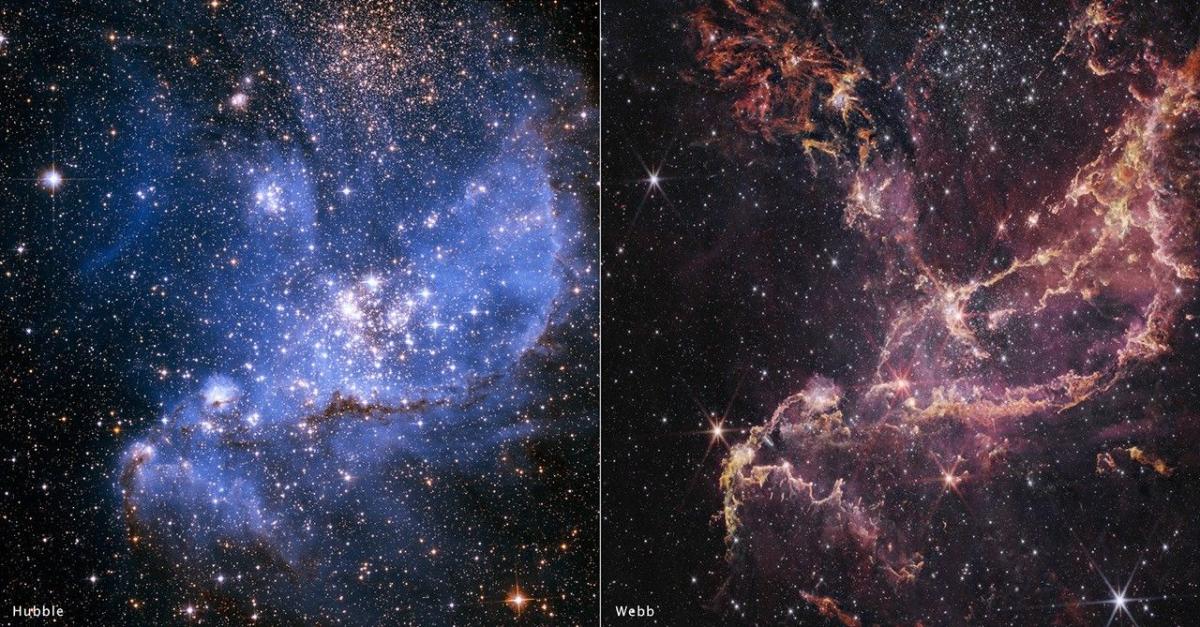

NASA’s groundbreaking discoveries with the James Webb Space Telescope have unveiled striking images of ancient stars, prompting a reevaluation of the theoretical models that explain the formation of planets. These remarkable visuals provide crucial evidence that had previously remained unverified, shedding light on the early universe’s mysteries.
The newly captured, high-resolution images showcase the “Small Magellanic Cloud,” which is a dwarf galaxy situated near our Milky Way. The Webb telescope concentrated its observations on a specific cluster known as NGC 346, which NASA identifies as an excellent representative of “similar conditions in the early, distant universe.” This region is particularly interesting because it is devoid of the heavier elements typically associated with planet formation, which raises intriguing questions about how planets could arise in such environments. The Webb telescope successfully captured a spectrum of light indicating the presence of protoplanetary disks around these ancient stars, contradicting earlier assumptions that these disks would have dissipated within a few million years.
NASA notes that past Hubble Space Telescope observations of NGC 346 conducted in the mid-2000s detected numerous stars estimated to be between 20 to 30 million years old, which appeared to retain their planet-forming disks. This notion was met with skepticism due to a lack of detailed supporting evidence. However, the Webb telescope has now provided the necessary data, reinforcing the idea that these disks in neighboring galaxies may have an extended timeframe to gather the dust and gas essential for forming new planets.
Regarding the persistence of these protoplanetary disks, NASA presents two compelling theories. The first suggests that “radiation pressure” from the stars within NGC 346 may take longer to dissipate these planet-forming disks. The second theory posits that in environments with fewer heavy elements, the larger gas clouds necessary for forming “Sun-like stars” might lead to the creation of larger disks that require a more extended period to fade away. Regardless of which theory ultimately holds true, the stunning new images serve as beautiful evidence that our understanding of planet formation remains incomplete and invites further exploration.


 Ethan Carter
 Brandon Fletcher