 Brandon Fletcher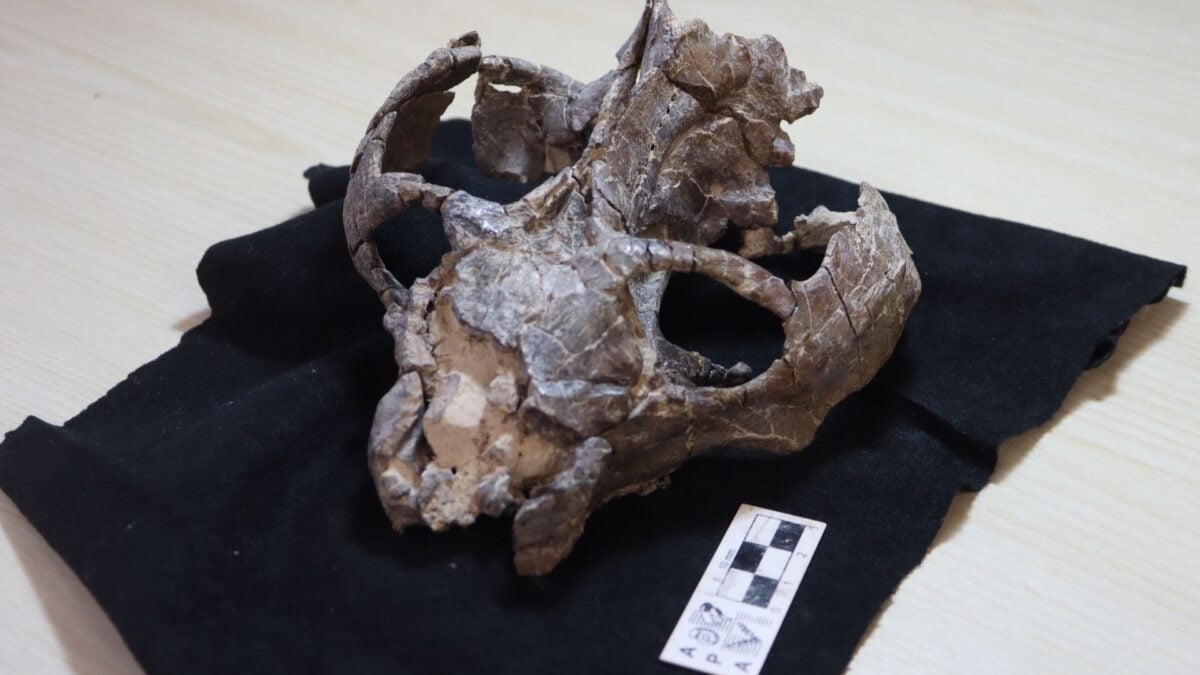

Most mammals, including humans, typically give birth to live offspring. this reproductive method is not exclusive to mammals, nor is it consistent across all species within this class. In fact, the ability to give birth to live young has evolved independently in various vertebrate groups, and some mammals, such as monotremes, lay eggs.
For many years, scientists speculated that cynodonts, a significant group of mammal-like reptiles from which modern mammals descended, also laid eggs. This assumption was based on the fact that egg-laying is common among reptiles and the earliest existing mammals, like the platypus and echidnas. Recent research, however, has provided new insights into whether cynodonts gave birth to live young or laid eggs, leading to groundbreaking findings.
A new study published in the journal Frontiers in Mammal Science presents the first fossil evidence indicating that a species of cynodont, Chiniquodon theotonicus, which existed approximately 236 million years ago during the late Triassic period, likely gave birth to live young. This discovery suggests that this evolutionary adaptation occurred 95 million years earlier than previously believed, according to the research team.
Uncovering a Groundbreaking Fossil Evidence
Maria Miceli Baro, a co-author and graduate student at the University of Buenos Aires, Argentina, was studying the bone microstructure of a mature C. theotonicus specimen when she made a remarkable observation.
“We were examining the samples when we noticed something unexpected,” said lead author Leandro Gaetano, a paleontologist at Argentina’s National Scientific and Technical Research Council, affiliated with the University of Buenos Aires. “We found embryonic tissue. This is highly unusual; I have never encountered anything like this before.”
Using data from extant species, Gaetano and the research team identified a neonatal line, a unique growth ring found in bones or teeth that forms due to the rapid growth that occurs immediately after birth. This finding provided a new avenue to test the widely held assumption that cynodonts exclusively laid eggs.
“We began exploring how we could utilize this new information to examine the prevailing hypothesis, and we devised a method to use body size as a proxy,” Gaetano explained.
Decoding the Reproductive Strategies of Cynodonts
The research team measured the neonatal line and the outer surface of the specimen to estimate its size and weight both at birth and at death. Their analysis indicated that the newborn C. theotonicus weighed about 3.7 pounds (1.7 kilograms) at birth and 26.5 pounds (12 kg) at the time of its death. This means that the newborn accounted for approximately 14% of its adult weight.
To understand the implications of this newborn-adult body mass ratio, the researchers compared it to various groups of living animals. Present-day reptiles, including turtles, snakes, and crocodiles, typically have hatchlings that weigh between 9 and 53 grams, translating to very low newborn-adult body mass ratios of around 0.1% to 0.6%. Larger birds, such as cranes, pelicans, and vultures, also exhibit low ratios of approximately 1.3% to 4.5%.
Placental mammals, which constitute about 95% of all living mammal species, demonstrate newborn-adult body mass ratios that closely resemble that of C. theotonicus. Species in this category, weighing between 17.6 pounds (8 kg) and 33.1 pounds (15 kg), can have newborns that weigh between 35.5 grams and 4.1 pounds (1.87 kg), with ratios reaching as high as 18.77%.
For instance, the bay duiker antelope, an African species, gives birth to young with weights comparable to that of a newborn C. theotonicus.
“In cynodonts, embryonic tissues had never been documented before, nor had a neonatal line,” Miceli Baro stated. “Our analysis revealed that traits associated with evolutionary success existed in these animals long before true mammals emerged.”
Although this research focused on a single cynodont species, Gaetano noted that their findings support previous studies suggesting that features seen in modern placental mammals—such as lactation, body hair, and brain size—were already developing in the ancestors of C. theotonicus. These traits may be linked to the genetic foundations necessary for live birth, indicating that such characteristics likely evolved simultaneously.
“It is highly probable that there was a transition from egg laying to live birth among these cynodonts,” Gaetano concluded.
The research team aims to examine more specimens in search of embryonic tissues to validate their findings. Their future investigations could shed light on the evolution of mammalian reproduction as we understand it today.


 Daniel Mercer