 Tessa Everly

X has unveiled new revelations about how its algorithm determines the visibility of user posts. This initiative aims to enhance transparency regarding how the platform’s algorithms promote or restrict specific updates, addressing concerns over possible content manipulation.
The recent update to X’s code repository, now available on GitHub , provides deeper insights into the functionality of its source code. X is exploring a more straightforward way for users to identify if particular posts have been shadowbanned or restricted.
According to X: “Today, we are making significant progress in our efforts to boost transparency. We are open-sourcing the code that influences a post’s visibility in the For You timeline, alongside a new tool that reveals labels applied to accounts or posts that may affect visibility. Our primary objective is clear — we want users to determine for themselves if a platform is limiting their reach, assess the fairness of the system, and understand why they are seeing specific content.”
The core update expands its GitHub repository, offering more information about X’s post ranking system, including content labels that can alter post visibility.
This enhancement allows users to gain deeper insights into the performance of their individual posts. At the same time, X’s VP of Product, Keith Coleman mentioned that users can now input the app’s source code into any LLM along with their account data to understand what impacts the visibility of their posts.
This process also introduces a second component. X is testing a new feature that enables users to download information on any labels or tags assigned to their posts over the last month.
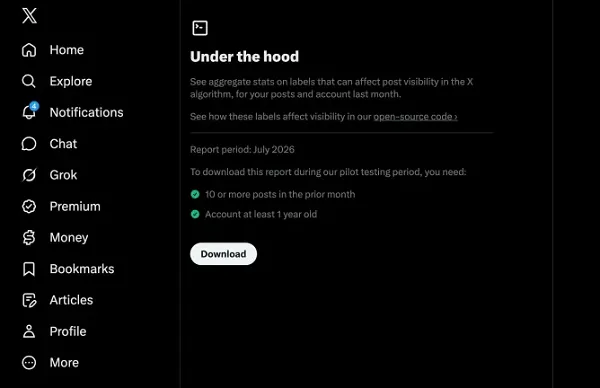
With these updates, X users who frequently post will be able to independently verify whether their content faces any restrictions and if X has applied any tags or limitations to their posts or profiles.
Deciphering this information may not be entirely straightforward, as it requires some manual effort to extract insights. for users participating in X’s creator revenue share program, this could prove to be a valuable exercise in understanding potential issues affecting content performance.
X aims for these added transparency measures to reassure users and clarify any uncertainties regarding alleged restrictions and shadowbans. While shadowbans may not be applied in the way many users perceive, account and post-level restrictions occur based on various criteria.
X hopes this update will alleviate concerns in this area, even though the company’s record on algorithmic transparency leaves much to be desired, despite its claims to the contrary.
In 2023, shortly after acquiring the platform previously known as Twitter, X owner Elon Musk sanctioned the release of a version of the app’s feed algorithm on GitHub. At that time, Musk pledged to provide regular updates, allowing anyone to view how posts are ranked and displayed in the feed.
Nonetheless, the data made available was merely a partial representation, with several elements omitted from public view. The code was also never updated as promised by Musk, leading to user frustration over the apparent lack of transparency.
Despite this, Musk has consistently labeled this as a significant milestone in transparency, asserting that X is the most transparent platform regarding content ranking insights.
Last month, Musk reiterated this commitment and promised to fully open-source X’s codebase again to foster greater trust among its users.
Given that he claimed X had already achieved this three years prior, this assertion felt somewhat disingenuous. this renewed initiative to enhance transparency may align with Musk’s broader objectives.
Regardless, these new insights could enhance understanding of potential reach limitations and penalties, igniting discussions about how X manages content amplification and suppression.
X announced it is piloting its individual post labels and tags tool with a randomized selection of eligible accounts that have been active for at least one year.


 Troy Sanders
 Ivy Caldwell