 Brandon Fletcher


For centuries, scientists have diligently tracked solar cycles, yet these cycles exhibit significant variation in both length and intensity. This variability poses challenges when it comes to accurately forecasting future solar activity. astronomers may have discovered a promising method to reduce this unpredictability.
A recent proposal suggests that by focusing on the Sun’s “switch-off” point, researchers could predict the Sun’s next activity cycle approximately six or seven years prior to its peak. This switch-off point marks a phase in the solar cycle when the Sun’s most intense weather phenomena abruptly cease. The research, spearheaded by Sandra Chapman from the University of Warwick in the United Kingdom, is set to be presented at the Royal Astronomical Society’s National Astronomy Meeting this week.
Sandra Chapman explained, “The Sun doesn’t gradually fall asleep and then slowly awaken again. Instead, we’ve observed that the most extreme space weather events turn off quite suddenly at a specific moment in every solar cycle. By identifying this moment, we have uncovered a new method to predict the activity level of the next solar cycle.”
Understanding the Irregular Nature of Solar Cycles
Approximately every 11 years, the Sun’s magnetic field undergoes a polarity reversal, resulting in a switch of its north and south poles. During these cycles, concentrations of magnetic field lines create sunspots—dark patches that appear on the Sun’s surface. These sunspots are often linked to significant weather phenomena such as solar flares and coronal mass ejections, making them vital markers for both solar weather and the solar cycle in scientific research.
Like many cosmic phenomena, solar cycles and sunspot activity can be irregular. Despite this, Chapman and her colleagues explored the possibility of identifying a useful pattern within solar activity. This inquiry led to the proposal of a “sun clock” in 2020, which mapped solar cycles onto a conventional clock framework. Through this research, the team discovered that the most intense space weather does not gradually diminish but rather “switches off” at a specific point in each solar cycle.
Identifying the Switch-Off Point for Better Predictions
The recent study builds upon these earlier findings. The team identified a correlation between sunspot counts at the switch-off point and the peak sunspot numbers in the subsequent solar cycle. This insight led researchers to develop a new forecasting technique that utilizes this metric to predict the intensity of future solar cycles well in advance, as well as to recognize changes in the solar dynamo—the mechanism that generates the Sun’s magnetic field.
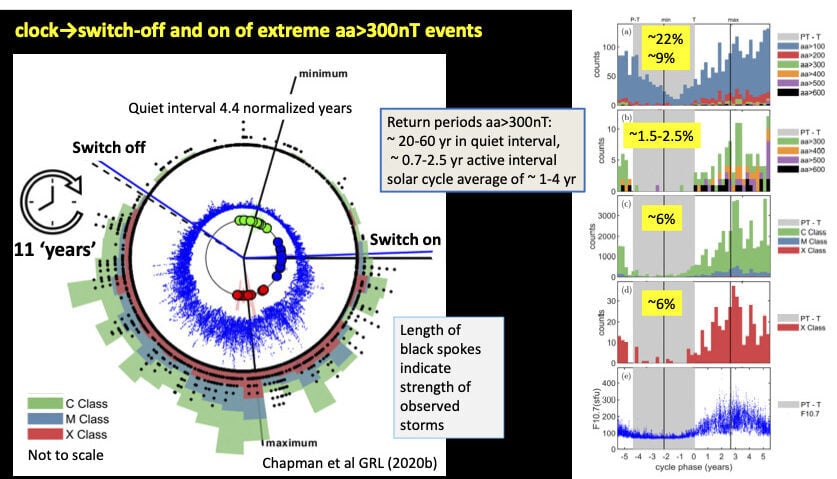
Currently, astronomers and space weather forecasters must wait until the solar minimum to gauge what to expect in the future, making this innovative approach a significant advancement. Initial tests indicated that the model effectively predicted the atypical intensity of Solar Cycle 25, a feat many earlier forecasts failed to achieve. Chapman remarked that the team plans to continue monitoring Cycle 25 using the new model to enhance its predictive accuracy with real-world observations.
“We are approximately two years away from reaching the switch-off point for the current Solar Cycle 25,” she noted. “At this stage, we must estimate where that point will occur, but once we arrive, we can rely solely on observations to make a much more accurate prediction for Solar Cycle 26. This will provide us with a warning of about seven years regarding the expected strength of the upcoming cycle.”


 Daniel Mercer

 Ethan Carter