Daniel Mercer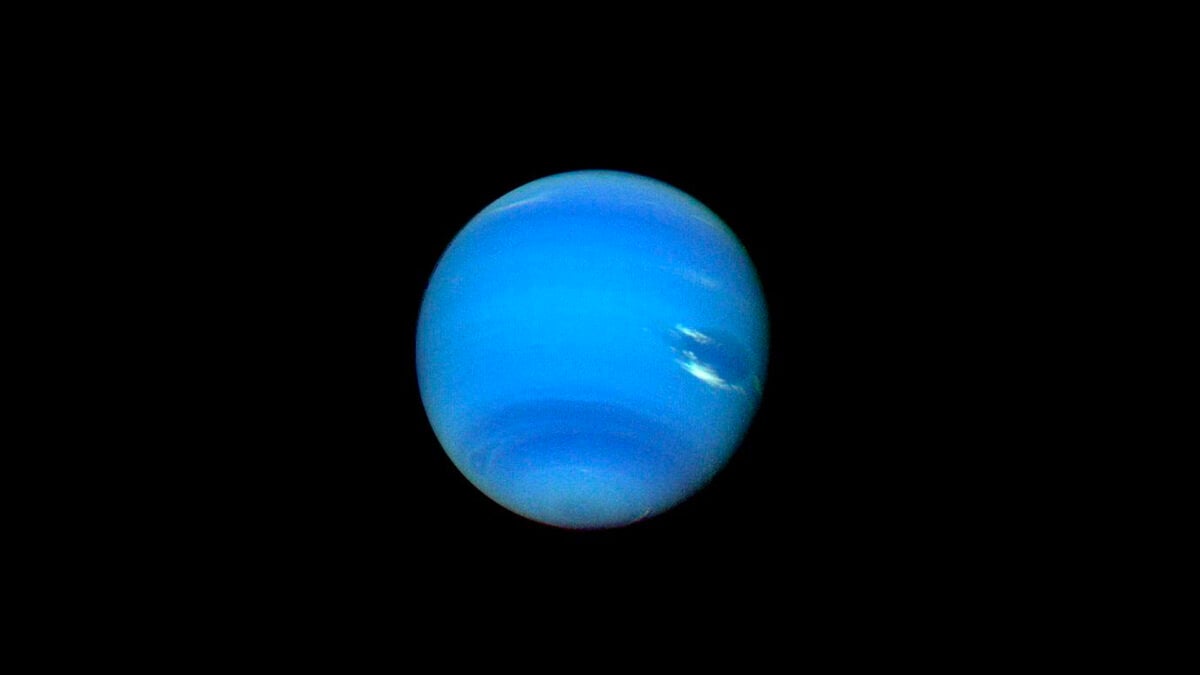

Neptune, the most distant planet from the Sun, boasts a fascinating and peculiar collection of moons. This unusual arrangement may stem from the tumultuous entry of its largest moon, Triton, into the planet’s orbit billions of years ago. Current scientific theories propose that Triton’s dramatic arrival led to the destruction of Neptune’s original moons, leaving only one survivor.
Recent research utilizing data from the Webb Space Telescope indicates that Nereid, one of Neptune’s moons, is the last remnant of this ancient cataclysm. A study published in Science Advances reveals new details about the chaotic dynamics of our solar system and its evolution over billions of years.
How Triton Changed Neptune’s Moon System
Triton, discovered just 17 days after Neptune itself, is nearly the size of Earth’s Moon and significantly larger than any of Neptune’s other moons. Uniquely, Triton orbits Neptune in the opposite direction of the planet’s rotation, making it the only large moon in the solar system to exhibit such an unusual behavior.
This oddity has led scientists to believe that Triton did not originate from the debris of Neptune’s formation. Instead, it is thought to be a Kuiper Belt object that was drawn in by Neptune’s gravitational pull nearly 4 billion years ago. As Triton entered its orbit, it likely caused substantial disruption to the existing satellite system of Neptune.
Another intriguing moon, Nereid, is the third largest of Neptune’s moons and has the most eccentric orbit of any moon in the solar system. Being one of the outermost moons, Nereid requires about 360 Earth days to complete a single orbit around Neptune. This eccentric orbit hints that Nereid may have also been captured by Neptune’s gravity.
Interestingly, the recent study suggests that Triton and Nereid may not share a common origin but could instead be longstanding adversaries in the history of Neptune’s moons.
Unraveling the Mystery of Nereid’s Survival
The research team, led by Matthew Belyakov from the California Institute of Technology, observed Nereid for a total of 10 minutes and 40 seconds using the infrared capabilities of the Webb telescope. Their findings revealed that Nereid is water-rich on its surface and shines brighter than many Kuiper Belt objects, suggesting that its composition is more akin to the moons orbiting Uranus.
To further investigate, the researchers conducted computer simulations to explore whether Nereid could have originated from Neptune’s original moon system. In simulations that depicted Triton crashing through Neptune’s satellite array, one or more moons survived on irregular orbits approximately 20% of the time.
The study posits that within the first 200 million years of the solar system’s existence, Triton’s dramatic entry into Neptune’s orbit would have likely obliterated the planet’s original moons. Nereid, however, might have avoided destruction, being propelled into an eccentric orbit.
This positions Nereid as the sole survivor of an ancient cosmic collision that eradicated its lunar companions, leaving it situated further from Neptune. This narrative paints a vivid picture of a young Neptune thrown into turmoil by Triton’s arrival, with Nereid standing as the last vestige of the planet’s original moon family.



 Brandon Fletcher