David Bridges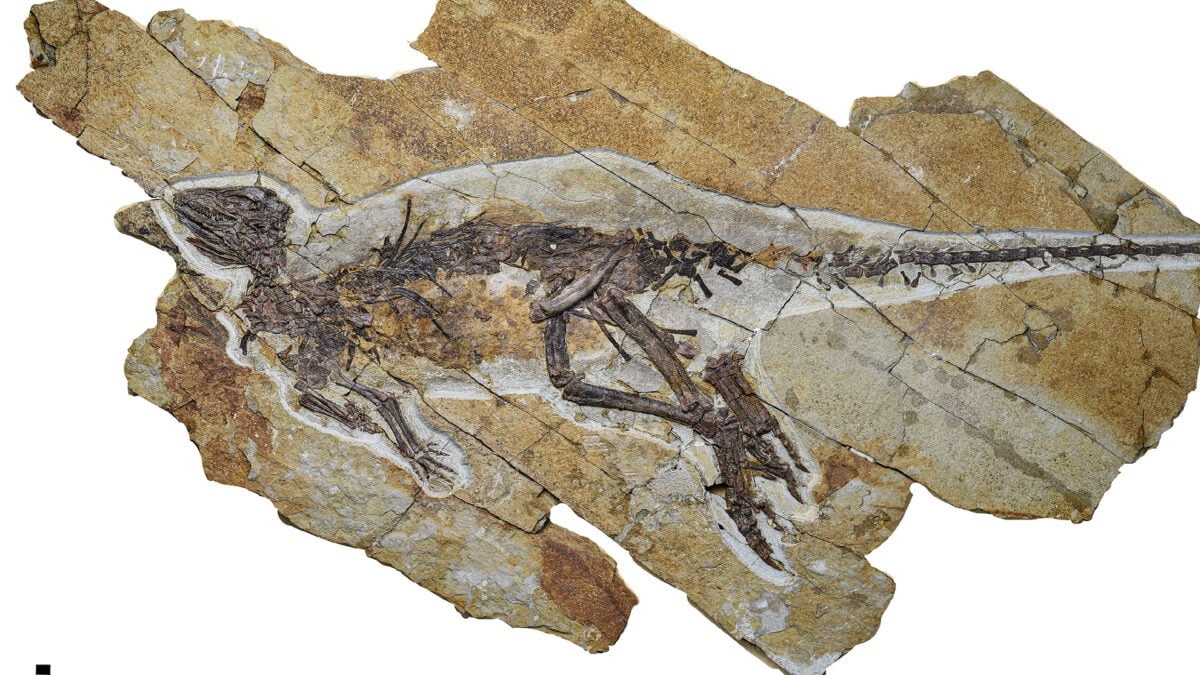
Recent discoveries by scientists have unveiled a remarkable dinosaur that may have produced sounds akin to a bird’s chirp. This groundbreaking finding indicates that the evolutionary roots of birdsong could be significantly older than previously believed, shedding new light on the evolutionary biology of vocalization.

In a detailed study published last week in the esteemed journal PeerJ, an international team of researchers presented their findings on a 163-million-year-old fossil unearthed in northeastern China’s Hebei Province. The fossilized dinosaur, named Pulaosaurus qinglong, measures approximately 28 inches (72 centimeters) in length and is remarkably well-preserved, allowing researchers to closely examine its anatomy, particularly its unexpectedly birdlike throat.
“Even when a dinosaur skeleton is preserved well, isolated bones that accompany other skull elements are not always intact,” noted Xing Xu, a prominent paleontologist at the Chinese Academy of Sciences in Beijing and one of the paper’s authors, in an interview with The New York Times. “These bones are incredibly thin and delicate, making them difficult to preserve.”
In vertebrates, vocal organs serve the dual purpose of safeguarding the airway while also generating sounds, which can range from basic noises like hisses and grunts to more complex vocalizations. In modern reptiles, these structures are primarily composed of cartilage and are relatively simplistic. In stark contrast, birds possess intricate, bony, and flexible vocal organs that enable them to produce a wide variety of sounds, thus showcasing their advanced vocal capabilities.
The anatomical features of Pulaosaurus‘ throat appear to be an intriguing blend of these two types. Its vocal structures bear a striking resemblance to those of another dinosaur, Pinacosaurus, an ankylosaur characterized by a large, bony larynx that may have possessed the flexibility required to generate birdlike chirps and tweets, as suggested by the researchers during their discussion with The New York Times.
The research team posits that Pulaosaurus thrived during the late Jurassic period and was part of the evolutionary lineage that eventually gave rise to the well-known “duck-billed” dinosaurs, such as hadrosaurs. However, it is important to note that Pulaosaurus and Pinacosaurus are separated by millions of years of evolutionary divergence, and neither species belongs to the lineage that ultimately led to modern birds. While it is plausible that they independently developed their vocal features, the presence of similar structures across such distinct species suggests that the ancient ancestors of dinosaurs may have exhibited surprisingly melodious characteristics.
This revelation implies that the roots of birdsong might trace back to creatures that walked the Earth over 230 million years ago. However, the exact timeline and mechanisms behind the evolution of the modern bird’s voice box, known as the syrinx, remain a captivating mystery, as do the vocal capabilities of any dinosaurs that may have shared these fascinating traits.



 Daniel Mercer
 Ethan Carter