David Bridges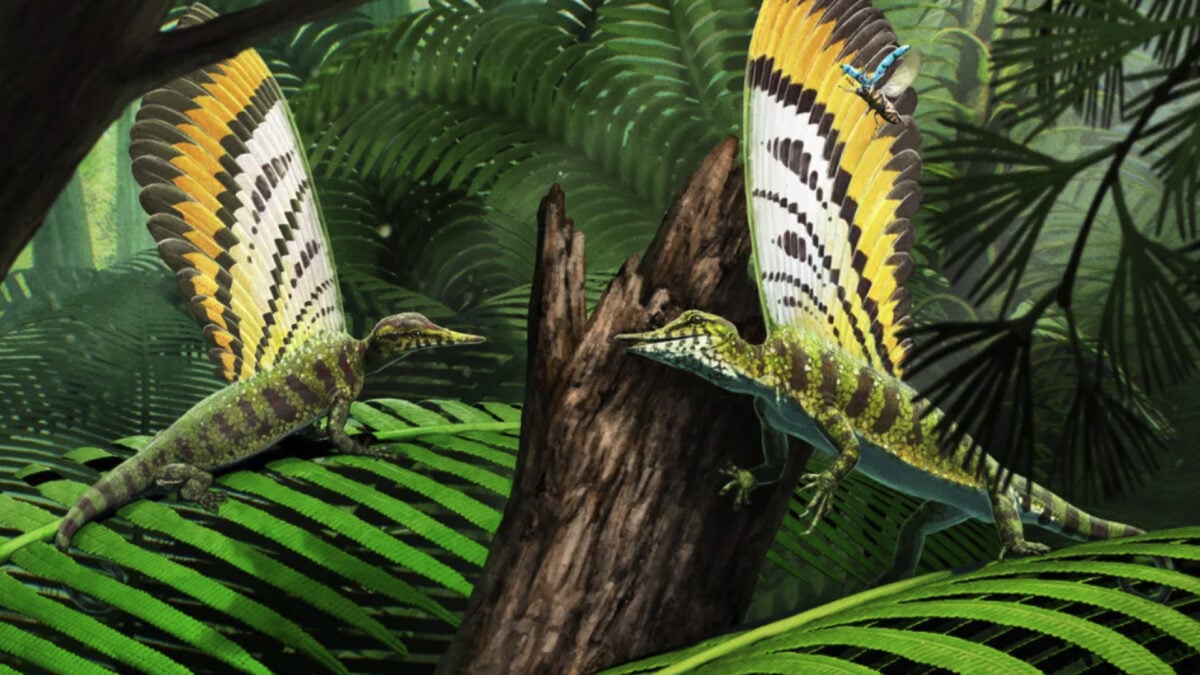

The rapid pace of technological advancements has transformed our understanding of the natural world, especially for paleontologists. These innovations allow researchers to examine softer materials—such as skin, feathers, scales, and hair—found within fossilized remains. This capability is leading to remarkable new discoveries about long-extinct animals, revealing that their characteristics are even more astonishing than previously thought.
In a groundbreaking paper published today in Nature, researchers present a thorough re-analysis of a fossilized Mirasaura grauvogeli, a remarkable 247-million-year-old reptile known for its distinctive feather-like structures protruding from its back. While many have traditionally perceived these features as feathers, the new study challenges this notion, suggesting instead that they represent a unique type of skin that fanned out from the creature’s back. The authors propose that this extraordinary structure likely functioned as a means of communication among these ancient beings.
These fascinating structures preserved pigment-carrying particles known as melanosomes, which exhibit characteristics more akin to birds than to reptiles. An intriguing aspect of these appendages is that they do not fit neatly into the categories of feathers or scales. Instead, they are described as “distinctly corrugated”—similar to the texture of cardboard—and likely possessed a degree of flexibility, as reported by the researchers in their study.
“This evidence uncovers the fact that vertebrate skin possesses evolutionary potential that is even more extraordinary than one might easily conceive,” explained Richard Prum, an evolutionary biologist at Yale University, who was not involved in this research. “Mirasaura shows us that a feather is merely one among many extraordinary adaptations that reptiles evolved to develop from their skin.”

As part of their analysis, a dedicated team of paleontologists at the State Museum of Natural History in Stuttgart, Germany, revisited an old fossil of Mirasaura that was originally discovered in 1939 and later acquired by the museum in 2019. Previously, researchers had little understanding of what the fossil represented; in fact, it was this team that successfully identified the creature for the very first time.
In a similar vein, paleontologists had difficulty fully comprehending Mirasaura‘s close relative, Longisquama insignis, which also displayed long, feather-like structures along its back. At that time, scientists struggled to interpret its significance, partly due to the Longisquama fossil’s poor preservation. However, for this new study, the team reconstructed the skeletal anatomy of both creatures, leading them to determine that Mirasaura and Longisquama were likely members of the drepanosaur family, an unusual group of reptiles hailing from the Triassic era (spanning between 201 million and 252 million years ago), often referred to as “monkey lizards.”

These drepanosaurs are as peculiar as they come, featuring long, bird-like skulls, bodies resembling those of chameleons, and anatomical characteristics that suggest a life spent among the trees. If the findings of this new research are validated, it implies that drepanosaurs might have possessed intricate, helical structures extending from their backs, similar to those observed in Mirasaura and Longisquama.
In the realm of paleontology, scientists utilize their expertise and critical analysis to deduce physical features from the available empirical evidence. This makes it even more astonishing that through such meticulous and advanced methodologies, researchers have essentially uncovered a reptilian counterpart to Transformers. Concurrently, these “rediscoveries” of ancient fossils yield incredible insights into our planet’s history, which is why the scientific community eagerly anticipates these revelations each time.



 Ethan Carter