David Bridges

In a recent discussion about the transformative role of artificial intelligence, Meta’s CEO Mark Zuckerberg emphasized that the company is increasingly integrating AI-driven systems into various facets of its internal operations, such as software development, advertising strategies, and risk evaluation. This strategic pivot not only enhances efficiency but also reflects the growing reliance on AI technology for critical decision-making processes within the organization.
Looking ahead, Meta is reportedly aiming to leverage artificial intelligence for as much as 90% of its risk assessment processes across its platforms, including Facebook and Instagram. This ambitious plan encompasses all aspects of product development and modifications to community guidelines, signifying a major technological shift in how the company approaches user safety and content management.
According to a report from NPR:
“Historically, when Meta introduced new features for platforms like Instagram, WhatsApp, and Facebook, dedicated teams of reviewers meticulously assessed potential risks: Could the feature infringe on user privacy? Might it pose threats to minors? Could it exacerbate the dissemination of misleading or harmful content? Until recently, these privacy and integrity reviews were primarily conducted by human evaluators. However, internal documents obtained by NPR reveal that automation will soon account for up to 90% of all risk assessments.”
This reliance on automated systems raises significant concerns about placing too much trust in machines to safeguard users from the more detrimental aspects of online interactions. The implications of such a shift could be far-reaching, potentially affecting millions of users.
Despite these concerns, Meta expresses confidence in the capabilities of its AI systems to effectively manage these responsibilities, including content moderation. This assertion was highlighted in the company’s recently released Transparency Report for the first quarter of the year, showcasing their commitment to leveraging technology for better governance.
Earlier this year, Meta announced a significant shift in its approach to “less severe” policy violations. The company aims to minimize enforcement errors and reduce unnecessary restrictions on content, promoting a more balanced approach to content moderation.
As part of this new strategy, Meta has stated that when its automated systems identify a high volume of errors, they will deactivate those systems temporarily for improvements. Additionally, they are:“…eliminating most [content] demotions and ensuring that there is a greater level of confidence required before content can be deemed a violation. Our systems will be adjusted to necessitate a much higher degree of certainty before any content is removed.”
Essentially, Meta is refining its automated detection mechanisms to prevent premature removal of posts. The company claims this initiative has already yielded results, as they report a significant:a 50% reduction in enforcement errors.
While this appears to be a positive development, it also raises concerns that a decrease in enforcement errors might inadvertently lead to an increase in the visibility of violative content within users’ feeds on these platforms.
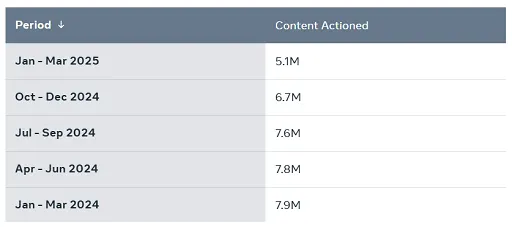
These issues are further underscored by the enforcement data Meta has released:
As illustrated in the accompanying chart, Meta’s automated detection of bullying and harassment on Facebook saw a decline of 12% in the first quarter, indicating that a greater volume of such content was slipping through as a result of these policy changes.
While the chart may not depict a dramatic impact, the reality translates into a variance of millions of violative posts that Meta is now acting upon more swiftly, alongside millions of harmful comments that users encounter on its platforms due to this shift in strategy.
Thus, the potential impact of these changes could be substantial. Meta is aiming to increasingly depend on AI systems to comprehend and enforce community guidelines effectively, thereby enhancing its operational efficiency on this front.
Whether this strategy will achieve its intended goals remains uncertain. This exploration is just one facet of how Meta intends to integrate AI technology to evaluate and enforce its diverse rules and policies, ultimately striving to offer better protection for its extensive user base.
As previously mentioned, Zuckerberg has indicated that within the next 12 to 18 months, a significant portion of Meta’s evolving codebase will be developed by AI systems.
Such an application of artificial intelligence seems logical, given its ability to process vast datasets and generate code based on established patterns and logical correlations. However, when addressing critical rules and policies that significantly influence user experiences across applications, it introduces a level of risk that warrants careful consideration.
In response to inquiries from NPR, Meta clarified that changes to product risk reviews will continue to involve human oversight, and that only decisions deemed “low-risk” will be automated. Nevertheless, this shift provides a glimpse into the potential future expansion of AI technology, where automated systems increasingly dictate user experiences.
Is this a prudent direction for managing such critical aspects?
While it may prove effective, it undeniably poses significant risks, especially when considering the broad scope of potential impacts that could arise from errors in judgment or decision-making.


 Sophie Langley
 Ivy Caldwell