David Bridges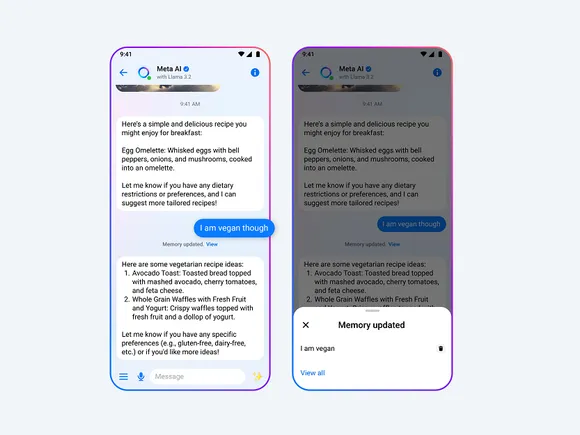

Meta is actively enhancing its AI assistant by introducing innovative memory features that will significantly improve its ability to recall and refine responses based on your unique personal preferences and interactions.
According to Meta,
“While Meta AI is on track to become the most widely utilized AI assistant, our vision is to create one of the most personalized AI experiences ever devised. At the end of last year, we began to gradually roll out a new feature that enables Meta AI to remember specific details shared in 1:1 chats on WhatsApp and Messenger, enhancing its ability to deliver personalized responses that are more meaningful and relevant to you.”
This enhancement illustrates how Meta is integrating advanced personal tracking tools to tailor your interactions with the Meta AI assistant. For instance, if you inform the chatbot that you follow a vegan lifestyle, it will retain that information and subsequently suggest only vegan recipes when you inquire about meal ideas.
Additionally, Meta is leveraging insights from your Facebook and Instagram profiles to further refine the assistant’s responses:
“Imagine you want to plan a fun family outing for the weekend and ask Meta AI for suggestions. Based on your Facebook profile’s listed home location, recent engagements with reels featuring live performances by various country artists, and its knowledge of your family setup, which includes a partner and two young children, Meta AI could propose tickets for a local country music event and reservations at a nearby brunch venue.”
While this level of personalization is impressive, it does raise concerns about privacy and data tracking, reminding users that Meta monitors activities across its platforms to enhance and optimize its services.
Many users are apprehensive about this aspect of Meta’s operations, which is why the company has introduced explicit controls over ad tracking and user preferences. It’s essential to clarify that Meta AI does not track everything you input:
“Meta AI will only remember select details shared during 1:1 conversations (excluding group chats), and you maintain the ability to delete any memories at your discretion.””
Although Meta remains vague about which specific elements it will retain, the system is designed to refine its interactions based on your preferences, focusing on logging information that enhances its responsiveness.
This could encompass a wide array of details.
In theory, if Meta aims to create the most tailored experience possible, it may ultimately track various personal preferences, including dietary choices, search behaviors, and other habits, ensuring that its suggestions align closely with your needs and interests.
Meta likely possesses a wealth of this information already, with prior reports indicating that Facebook understands its users better than their closest relationships. However, Meta has indicated that it will not integrate all this backend data into Meta AI, suggesting that it will maintain a separate data architecture specifically for the AI assistant.
Nevertheless, if Meta genuinely seeks to personalize its offerings, and users demonstrate a desire for extensive customization…
It’s important to highlight that Meta is investing heavily in building substantial AI data centers to support these initiatives, with CEO Mark Zuckerberg recently pledging an impressive $65 billion in AI-related capital expenditures this year.
That’s an enormous volume of data that Meta is set to track, which may raise concerns among users regarding privacy and data security.
There seems to be a resurgence of apprehension regarding Meta’s extensive data collection practices, especially as the company intensifies its focus on AI development and responds to market demands for rapid AI solutions to maintain the U.S.’s competitive edge in technology.
This situation is further complicated by the emergence of Chinese AI assistant app DeepSeek, which employs a distinctly different approach to AI training and data utilization, potentially yielding superior and faster outcomes.
Meta certainly has a significant advantage in terms of user data, possessing more information about individuals than any other organization in history, which could translate into a major competitive edge. However, this dominance also subjects Meta to increased scrutiny and potential regulation, especially in light of past investigations concerning its data usage and responsibilities surrounding user privacy.
If Meta exceeds acceptable boundaries, regulators could intervene, particularly in Europe, which has already begun to limit Meta’s AI deployment to evaluate the implications for privacy.
Announcing these new personalization features may not alleviate existing concerns surrounding privacy and data security. Perhaps this is why Zuckerberg is eager to foster positive relations with the current administration.
Meta has stated that it is currently rolling out these new personalization features for Meta AI on Facebook, Messenger, and WhatsApp across the United States and Canada.



 Maya Kensington
 Sophie Langley