David Bridges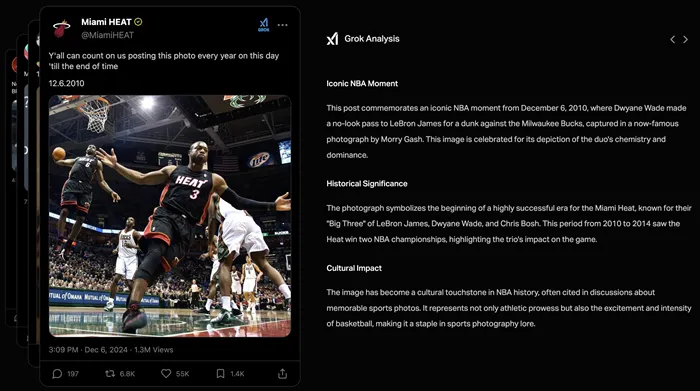

Recently, X has been making significant strides in enhancing its Grok AI chatbot, which is now accessible for free to all users, marking a pivotal moment in its development.
Grok serves as the flagship product of Elon Musk’s xAI initiative, distinct yet tied to X Corp. This innovative chatbot leverages insights from the X platform to generate its responses, creating a seamless integration between the X app and the advanced technologies of xAI.
With xAI successfully securing an additional $6 billion in funding and establishing a substantial AI computing cluster in Memphis, X and Musk are eager to encourage broader adoption of Grok. The goal is to demonstrate its capabilities and position it favorably against other generative AI chatbots currently available in the market.
To improve the quality of interactions, X has integrated more robust X and web search data, significantly enriching Grok’s responses and ensuring users receive accurate and relevant information.
In this illustration, you can observe that Grok’s responses now feature reference links and citations, which not only enhance clarity but also provide contextual background to its outputs, making the information more reliable for users.
Additionally, the latest updates have refined Grok’s image generation capabilities and introduced a revamped Grok button on X posts. This new feature simplifies the process of obtaining more context on any specific X post in real-time, enhancing user engagement and interaction.
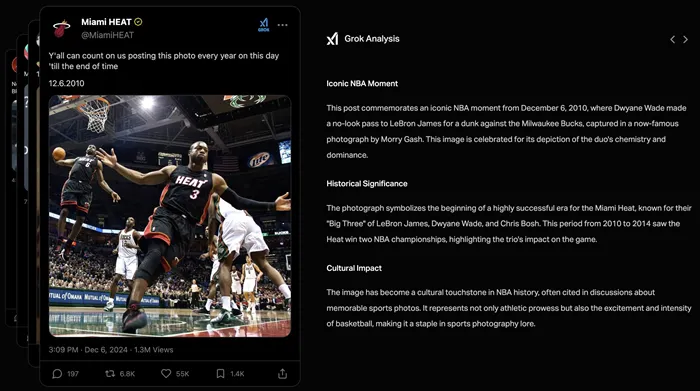
You will also notice the newly designed Grok icon associated with this updated button. The transition from the previous box-with-a-slash design to a modern logo serves to clearly distinguish its functionality and improve user experience.
Moreover, X is currently testing audio query functionality for Grok, allowing users to ask questions vocally, thereby streamlining the interaction process and aligning it with modern conversational interfaces.
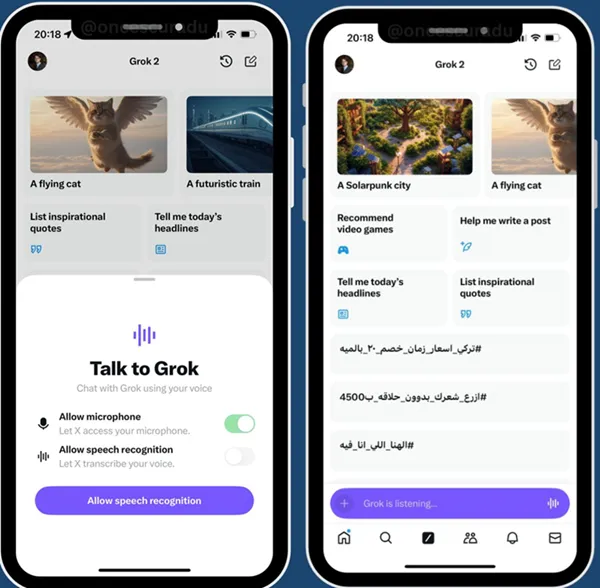
This feature would align Grok more closely with Meta AI, which has already embraced voice queries in its Ray-Ban Meta glasses, showcasing a trend towards hands-free interaction in AI technology.
However, it’s important to note that Meta AI is not the primary competitor that Musk has in his sights for his generative AI venture.
Musk’s main target is OpenAI, the organization he co-founded but later distanced himself from due to disagreements over leadership and control. His vision for AI is rooted in a desire to direct its development towards specific goals.
According to reports, during the inception of OpenAI in 2016, Musk committed $100 million in funding to the project, which aimed to advance AI development in a safe and transparent manner. His ambition to lead the organization was met with resistance from the OpenAI board, leading to his exit from the initiative and a partial retraction of his financial support.
As time went on, OpenAI evolved into a significant entity, generating revenue from its projects. Feeling rejected and frustrated by the outcome of his initial investment, Musk was prompted to establish his own AI initiative, which he hopes will outperform OpenAI.
This drive for innovation is also intertwined with Musk’s other ventures, notably Tesla, which is pursuing advancements in full self-driving technology. His commitment to AI development is evident in the progress of Grok, which encapsulates xAI’s current achievements.
While I remain skeptical about the tangible benefits that AI chatbots bring to the social media landscape, it will be interesting to see how users of X, which boasts 570 million users, will perceive the value of Grok now that it is freely available.
Nonetheless, the primary focus for xAI may not solely rest on immediate user engagement, as the company continues to explore innovative applications for its technology and refine its offerings.
However, Grok is making strides in its development, and for those seeking a capable AI chatbot, its integration with X’s real-time information could indeed prove beneficial.



 Maya Kensington
 Cameron Steel